
Militha Mihiranga
Data Mining Expert | DT Linux (Data Tune) - Sri Lanka
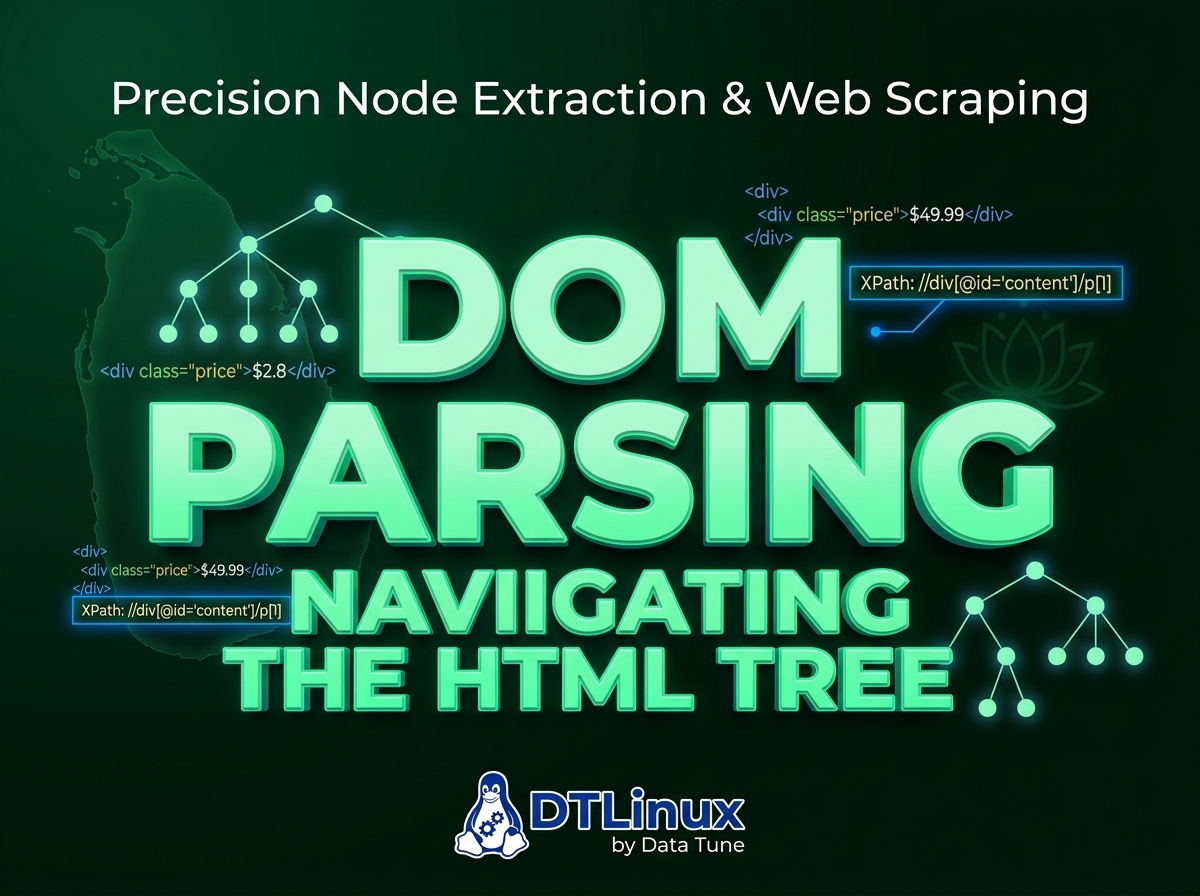
DOM Parsing: Extracting Specific Node Structures from Web Documents
When APIs are unavailable or hidden behind strict security layers, extracting data directly from a website's frontend becomes necessary. However, a web page is not just a flat document of text—it is a complex, hierarchical database of elements. To extract information accurately, we use a highly structural approach known as DOM Parsing.
At Data Tune (operating under DT Linux), we treat web scraping as an exercise in mathematical precision. By navigating the Document Object Model (DOM), we can surgically extract exact data points—like prices, reviews, or contact details—while ignoring the surrounding noise, design elements, and advertisements.
The Mathematics of DOM Navigation
The DOM represents an HTML document as a logical tree. To build reliable data collecting pipelines, we rely on Graph Theory. Here is how we mathematically approach node extraction:
Where V is the set of HTML nodes (e.g., <html>, <body>, <div>, <p>).
Where E represents parent-child relationships (Edges).
To extract a specific data point, we define a Path P using XPath or CSS Selectors:
P(v_target) = (v_root → v_1 → v_2 ... → v_target)
Our scraping algorithm runs a Depth-First Search (DFS) to locate V_target where attribute conditions (like class="price") evaluate to True.
By mapping the website as a mathematical tree, our scrapers know exactly which branches to traverse and which to ignore. This makes our data mining incredibly efficient and resource-light.
Our DOM Parsing Process
1. Tree Construction (Parsing the HTML)
We download the raw HTML source code of the webpage. Using powerful parsing libraries like `lxml` or `BeautifulSoup` in Python, we convert this messy text string into a fully navigable memory tree. If the page is heavily reliant on JavaScript, we use headless browsers like Playwright to construct the rendered DOM.
2. Node Selection (XPath & CSS Selectors)
This is where precision matters. We write exact structural paths to target specific nodes. Instead of searching for the word "Price", we tell our bot to find the 3rd `` element inside a `
3. Attribute & Text Extraction
Once the correct node is located, we extract the inner text (the data itself) or the node's attributes (like extracting a URL from the `href` attribute of an `` tag). We then sanitize this text, strip out unwanted whitespace, and format it into clean columns for delivery.
Pros and Cons of DOM Parsing
Pros (The Benefits)
- Surgical Precision: Extract exactly what you need from highly complex layouts.
- Attribute Access: Easily pull hidden metadata, image links, and SEO tags.
- Universal Application: Works on almost any website, even those without APIs.
Cons (The Challenges)
- Structural Fragility: If the website designer changes a class name or moves a div, the scraper path breaks.
- Rendering Overhead: Parsing massive DOM trees takes more memory than direct API extraction.
- JS Hydration: Requires expensive headless browsers for Modern single-page applications (React/Vue).
Need Precise Data Collecting Assistance? Outsource to Data Tune
Maintaining DOM parsers requires constant technical vigilance. If your business relies on accurate web data, outsource your scraping pipelines to our technical hub in Sri Lanka. We write resilient XPath selectors and maintain your scrapers so you always receive clean, uninterrupted data.