
Militha Mihiranga
Data Solutions Consultant | Data Tune (DT Linux) - Sri Lanka
Visual AI in Retail: How We Mine Image Datasets for Produce Ripeness Tracking
In high-value retail markets across the USA, Europe, Canada, and Australia, food waste is a multi-billion dollar problem. AgriTech startups and major grocery chains are deploying Computer Vision AI to automatically track fruit and vegetable ripeness on store shelves. However, AI cannot identify a rotting banana or an unripe avocado without massive, highly accurate visual machine learning datasets.
At Data Tune (operating under our managed services brand DT Linux), engineering teams frequently contact us for research help and complex data collecting assistance. As a Sri Lanka-based data solutions consultancy, we specialize in extracting and annotating unstructured image data. Here is our expert guide on how we perform visual data scraping and data mining to build these cutting-edge datasets.
Our Tricky & Conscious Image Data Mining Mechanism
Stock photos are useless for training robust AI. You need messy, real-world images from varied lighting environments. To extract these, I operate as a tricky collector, bypassing web restrictions to gather raw visual data from grocery delivery platforms and supply chain portals. We then apply a conscious, statistical approach to clean and annotate the data securely.
Step 1: The "Tricky" Extraction (Visual Data Scraping)
The first step is highly targeted data scraping. When a client requests visual custom web scraping services, we deploy automated headless browser scripts targeting e-grocery review platforms, agricultural supply chain dashboards, and retail inventory portals. By rotating residential IP proxies, we stealthily extract tens of thousands of high-resolution user-uploaded and inventory photos of produce on shelves, in varied lighting conditions.
Step 2: Conscious PII Sanitization (Image Cleansing)
Real-world images often accidentally capture human faces, store employee nametags, or proprietary store barcodes. We apply a conscious sanitization pipeline, utilizing automated blurring algorithms to scrub any Personally Identifiable Information (PII) from the image backgrounds, ensuring total GDPR and CCPA compliance.
Step 3: Analytical Data Mining & Bounding Box Annotation
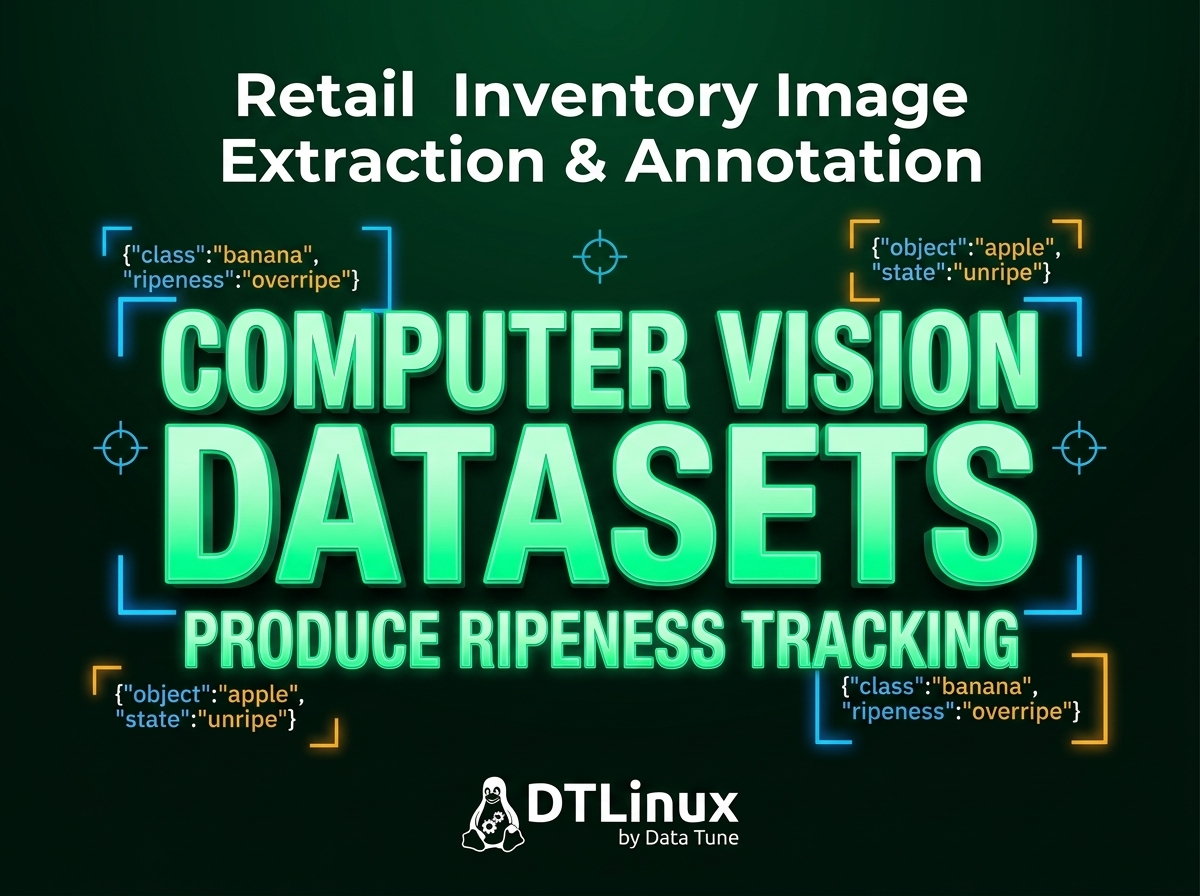
Gathering images is just data collecting; the real value is in the data mining. Our technical analysis team manually and semi-automatically annotates these images. We draw precise bounding boxes around the produce and apply strict metadata tags based on visual analysis. For example, a single image might yield JSON data like: [CLASS: Tomato] and [RIPENESS: Overripe/Wrinkled].
Step 4: Statistical Dataset Balancing
An AI trained only on perfect red apples will fail in a real supermarket. We use statistical validation to ensure your dataset is balanced across all classes—guaranteeing equal representation of underripe, perfectly ripe, and rotting produce across different lighting and camera angles.
Need Computer Vision Datasets? Outsource to Data Tune
Stop wasting your ML engineers' time on manual image scraping and annotation. Whether you need ongoing research help, complex visual data collecting, or want to hire an extraction expert, you can outsource your entire data pipeline to our technical hub in Sri Lanka. We build custom data architectures for enterprise clients globally.
Hire a Data Extraction Expert Today
Don't let poor training data ruin your Computer Vision AI. If you need highly specific, technically annotated visual intelligence, reach out to Data Tune today.